

Buying your first (or even second) vintage watches can feel daunting. If you want to know more about vintage timepieces from a technical standpoint, I’d suggest starting with our User’s Manual. But this simple guide will take you through the Where, the Who, the What, and the How of buying a fine vintage timepiece.
I. Where to Shop
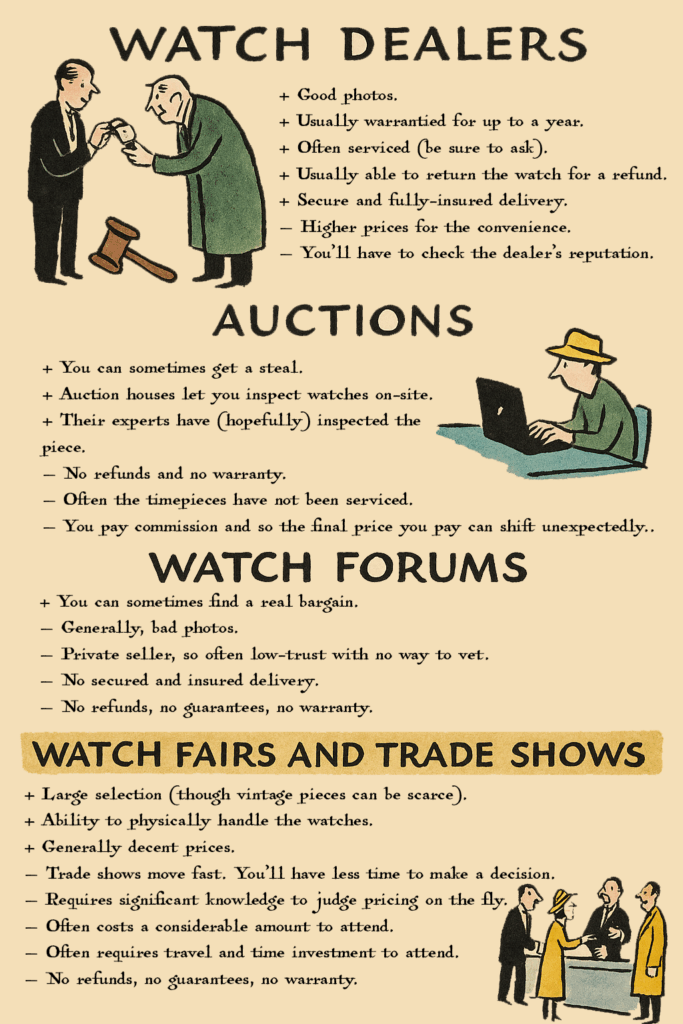
It seems like vintage watches are everywhere these days, but unless you’re being gifted a vintage watch or are inheriting one, you’ll have to buy it from somewhere. There are four main categories of where to buy, each with their own pros and cons:
II. Who to Buy From
Whether it’s a dealer or an auction house, it’s essential to find out if who your buying from is trustworthy, has a good reputation, and ideally positive customer reviews. Search online for all of the information you can find on them. Take individual reviews with a grain of salt, but use multiple sources such as Google, Yelp, Instagram, Chrono24, and watch forums, to see the larger picture.
III. What to Look For
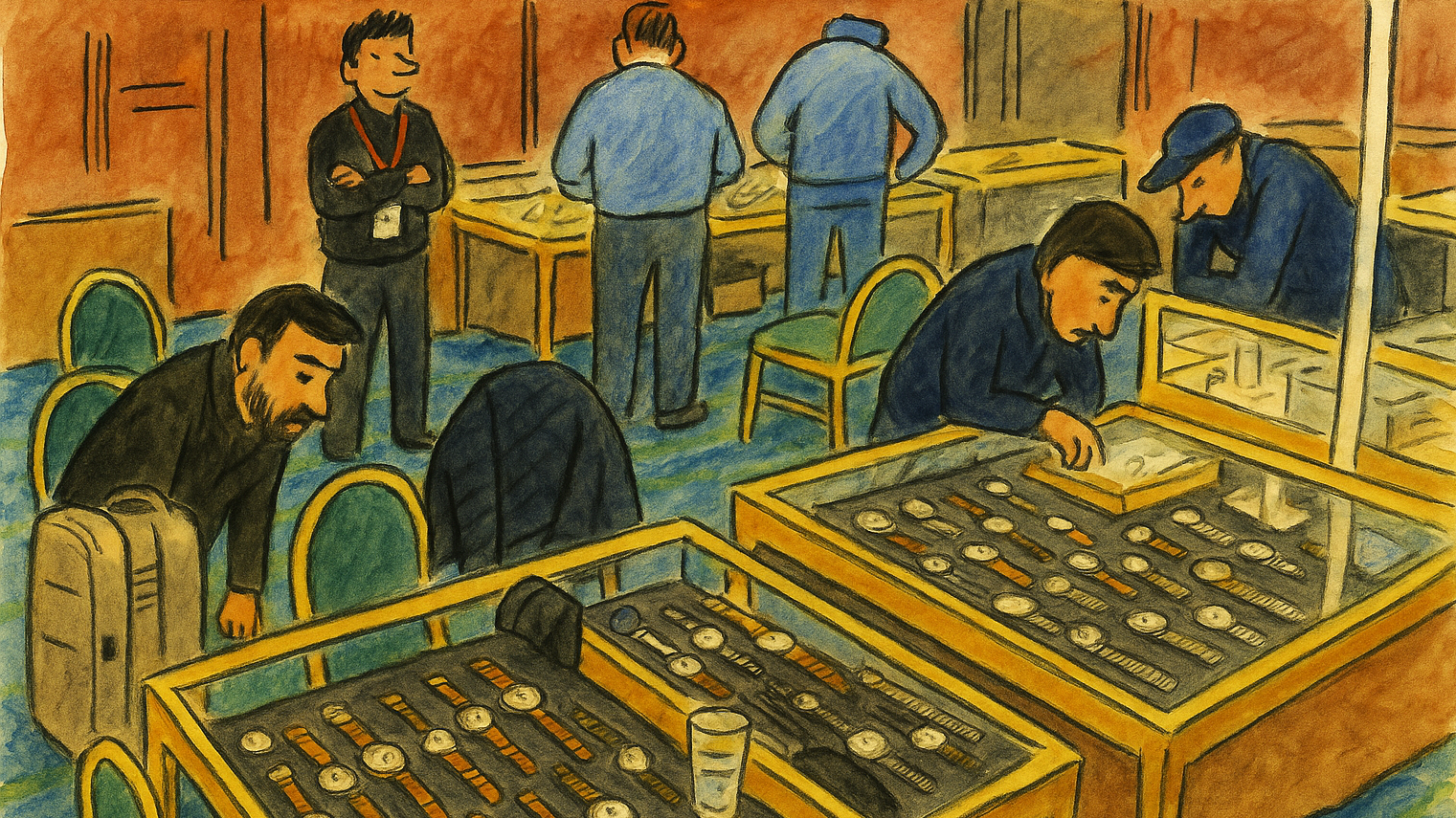
Buy what you know. Obviously a good dealer will be happy to teach you whatever they know about a timepiece, but otherwise you’re on your own. You’ll need to acquire sufficient information and you’ll want to make sure you’re working with decent photos to help make your decision.
Find the watch that speaks to you, and then read watch books, magazines, forums, Chrono24, and search online for other examples of the same reference. You’ll want to take everything you read online with a grain of salt, but all of the different sources should add up to a larger more-accurate picture. Then you’ll want to take this checklist with you as you weigh your purchase (and if you don’t know what these parts of a watch are–check out our User’s Manual). These are the top areas to look for (and at) when you’re evaluating a vintage watch:
- CASE
- Polishing:
- Is it unpolished, lightly polished, or over-polished? It’s definitely over-polished if the case shape has become malformed from removing too much metal. This should be reflected in a significant price decrease.
- Bezel:
- If the watch has a bezel, does it appear correct? It terribly very common, but it also isn’t unheard of for a bezel to have been replaced. The incorrect bezel can significantly decrease a watch’s value. You’ll want to closely compare the bezel to other examples of the same reference.
- Dents & Scratches:
- Obviously this will depend on personal preference.
- Brown & Rust:
- This can be indicative of water exposure and damage. While relatively easy to remove from a case, it can signal problems with the movement (see below). This is particularly clear if there is rust around the crown as this is the most frequent point of entry for water.
- Overall Condition:
- A consistent pattern of light wear throughout the watch is generally considered acceptable and normal with a vintage piece. Mint or near-mint examples are extremely rare and command significant premiums. Generally, if you’re going to be actually wearing the watch, it shouldn’t particularly matter if it’s seen a bit of wear–it’s part of the charm of a watch with some history. If something looks brand-new, and the rest of the watch is very worn, it could be that part has been replaced. Or not.
- Polishing:
- DIAL
- Originality:
- Has the original dial been refinished? Has it been replaced? This is one of the greatest determiners of value and can be very difficult for the layperson to determine.
- A giveaway is often the text, the markers, or the luminous application. Crude painting or a lack of uniformity can be indicative of a problem. For example, a logo that is uneven, crooked, or too-bold.
- Damage:
- Pay close attention to the dial surface. Is it considerably scratched? If it was damaged in a non-natural way this is usually a bigger problem than if it aged with an attractive patina. This is often very subjective. One man’s opinion of ugly radium staining is another man’s treasure.
- Originality:
- HANDS
- Originality:
- Are the hands original? Incorrect hands can have a large effect on a watch’s value.
- Is the luminous original? Does the luminous on the hands match the luminous on the hour markers?
- Originality:
- CRYSTAL
- Originality:
- Is the crystal original? It can add value, but not much. Vintage crystals are generally rare, but not expensive and replacements don’t decrease value significantly as they would with a dial.
- Breaks and Scratches:
- Are there breaks and scratches on the crystal? A broken crystal can indicate that the watch took a hit or a fall which can mean significant internal damage.
- Originality:
- MOVEMENT
- Rust:
- Is it brown and rusty? This can indicate water damage and future significant repair costs from your pocket.
- Originality:
- Is it the right movement for a watch of this period and reference? Check any case, calibre, and serial numbers that are visible (see below). If not, it may have later been replaced in service. This can massively effect value.
- Performance:
- Does the seller indicate how the movement is performing? Depending on the model +/- 30 seconds per day was generally considered normal for vintage watches in their day.
- Rust:
- CROWN
- Originality:
- Is it the correct crown for the model and year of production?
- Originality:
- BRACELET OR STRAP AND BUCKLE
- Originality:
- Do they appear to be original to the watch? Having a fully original bracelet with all links can add significant value. Generally people expect straps to wear out over the decades, but it can be a nice plus to have the original buckle.
- Condition:
- Is the bracelet significantly stretched? If a bracelet was worn very tightly over the decades it may become very loose. A loose bracelet will decrease the value of a watch as it can be cost-prohibitive to repair.
- Originality:
- REFERENCE, CALIBRE, AND SERIAL NUMBERS
- Serial Numbers:
- Look up any numbers on the case and movement. If you can find a serial number database for a brand, it can give you a rough idea as to whether or not the watch your looking at is correct or not. Keep in mind that dating for most brands is generally based on guesswork, and not highly accurate, but it can give you a rough idea.
- Dating Issues: Serial numbers and dating is not always accurate to when a watch was sold. It’s not uncommon for a watch case to have been manufactured years before it was put out for sale and then actually sold. Again, take everything you read online with a grain of salt. The main thing is to look at as many examples of that same model as possible.
- Reference and Calibre:
- Making sure that the reference or model fits the calibre on a movement can be very helpful in getting an overall picture of the overall originality of a timepiece. Keep in mind however, to take everything you read on forums with a grain of salt. Exceptions can and did occur often in the world of vintage watchmaking.
- Serial Numbers:
IV. What Else Is Important?
As with most things in lift, what’s important can be very suggestive, and ultimately it comes down to what is make or break for you. Below are some of the items you’ll want to ask about or review as you make your final decision on a timepiece.
Service History
It’s important to know the watch is functioning well. Replacing broken parts can get very expensive. It’s important that a watch has been serviced by a professional watchmaker. Bringing it to a watchmaker yourself can easily raise your bill by $300 – $600 USD depending on the brand and model. It can also also mean waiting weeks (or months, if a part is hard to find) until you can actually wear the timepiece. You don’t want to buy someone else’s abandoned “project watch.”
That’s why every watch at GAUTHIER Watches has either been recently fully serviced before listed for sale by one of our expert watchmakers, or has been inspected by our watchmakers and confirmed to have recently received a proficient service.
Box And Papers
It’s great to have the original Box and Papers for your watch, but it’s not considered essential. While it’s more expected when you’re buying a pre-owned timepiece, it’s relatively uncommon with vintage. It’s also relatively easy to create a fake piece and purchase a period-correct box for a couple hundred dollars. You also can’t wear the box, or the papers. Those considerations are a big part of the reason why for value, condition is considered to be far more important.
Condition
In terms of condition, mint or near-mint examples are extremely rare and command significant premiums. Generally, if you’re going to be actually wearing the watch and it won’t be living full time in a safe, light wear and a few blemishes won’t matter to you (or most normal people).
Love
The most important thing is that you actually love the timepiece.
Spencer Gauthier is the founder of GAUTHIER Watches and editor of GAUTHIER’S Vintage Watches & Culture Magazine.
